Oura or RingConn? The Smart Ring for Women You Charge Less Often
If you want the fewest charges and no membership fee, pick RingConn Gen 2. Fittr lists its battery at about 10 to 12 days per charge, and Oura is the ring three guides say needs a paid membership.
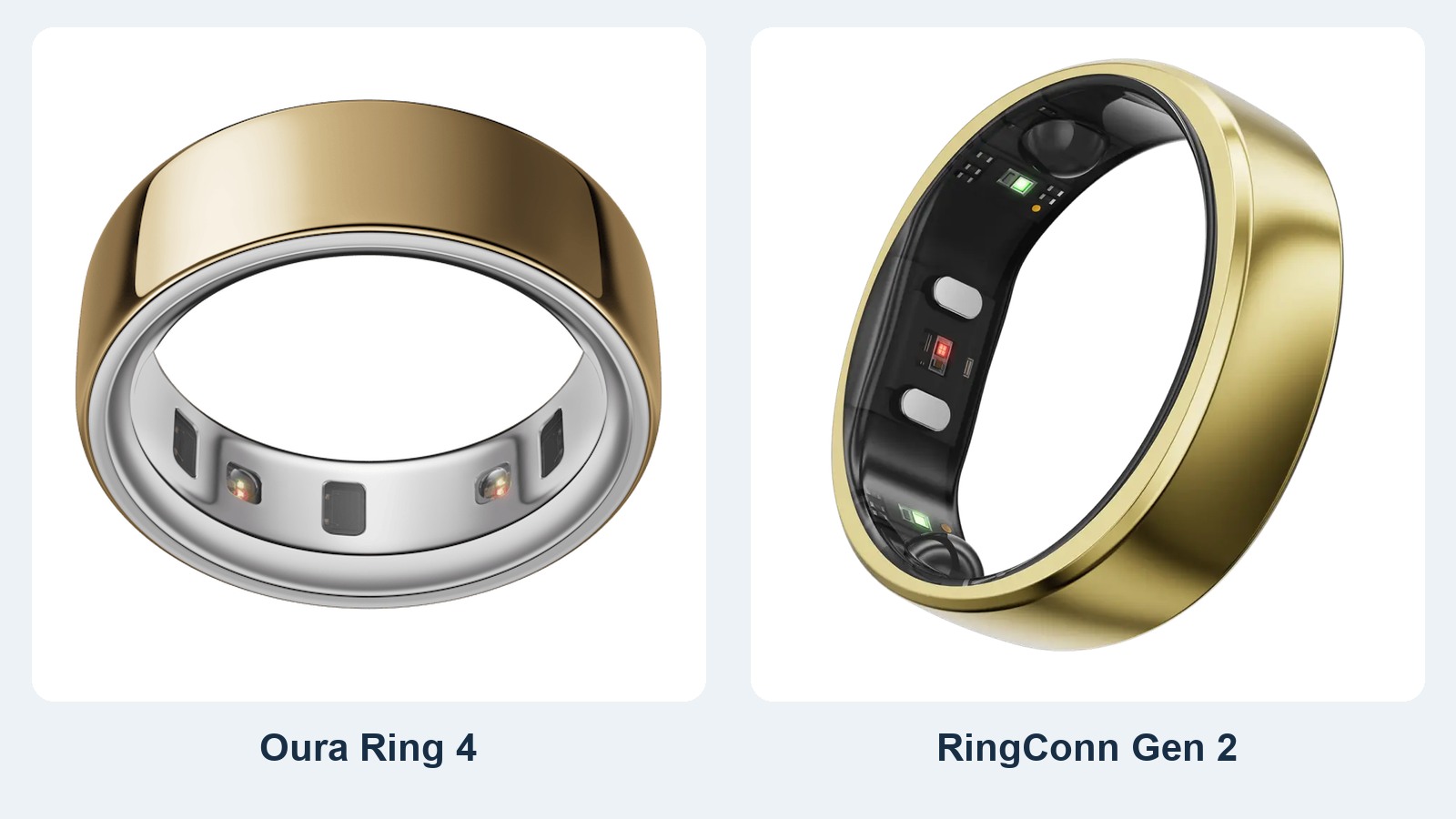
At the low end of CUDIS’s battery figure for Oura, you’d plug that ring in about 73 times a year; at the low end of Fittr’s figure for RingConn Gen 2, about 37 – roughly half as often. If you’re choosing a smart ring for women, you feel that gap every week, long before a sensor list matters. The same goes for the membership fee and the nights the ring sits on your nightstand because you forgot to put it on.
Two Guides Rank RingConn Gen 2 First on Battery Life
Fittr’s 2026 guide says RingConn Gen 2 “leads the field with around 10 to 12 days per charge plus a charging case”. Circular picks it for “the longest battery life.” On a long battery you plug in less often, so you’re less likely to lose a night because the ring was charging at bedtime.
Oura Ring 4’s battery figure depends on which page you read. Circular lists it at “up to 7 days”. CUDIS puts it at 5 to 8 days. Plan around the lower number, because that’s the one you’ll notice in a busy week.
Read these as rival claims. Circular, Fittr, Belle Health and CUDIS each sell a ring of their own, so every Oura and RingConn figure here comes from a competing brand.
Oura Is the Ring Three Guides Flag for a Paid Membership
Circular, Belle Health and CUDIS each say Oura needs a membership on top of the ring. So what Oura really costs is the ring price plus that fee for every month you keep using it.
RingConn is the other case. Circular’s table shows no subscription for it, and Belle Health says RingConn includes its features “without a monthly fee.”
Circular’s page lists RingConn Gen 2 at $299 and Oura Ring 4 at $349 (read Oct 2026). With no fee, RingConn’s three-year cost stays $299, or $299 ÷ 36 = $8.31 a month. Oura starts $50 higher, then adds the fee: $349 + (36 × monthly fee).
Take the fee from Oura’s checkout on the day you buy, since prices change. For a side-by-side of fees, see titanium smart rings compared on subscriptions and sizing.
CUDIS makes the same no-fee pitch for its own ring. Its July 14, 2026 guide says “AI-powered health services are already included in the $349 price”. If you take the maker at its word, the three-year sum is $349 + $0 in extra service fees = $349, or $349 ÷ 36 months = $9.69 a month. That claim comes from the company selling the ring, not from an independent review.
Side by Side: RingConn Needs About Half as Many Charges as Oura
This table puts each page’s battery claim next to how often you’d plug in, plus price and membership. The charge counts are simple division: 30 days ÷ claimed battery days.
| Ring | Battery claim (pages read Oct 2026) | Charges per 30 days | Membership | Price and what it covers |
|---|---|---|---|---|
| Oura Ring 4 | Up to 7 days (Circular); 5 to 8 days (CUDIS) | 30 ÷ 8 = 3.75 to 30 ÷ 5 = 6 | Yes, per Circular, Belle Health and CUDIS | $349 ring only, per Circular; membership extra |
| RingConn Gen 2 | Around 10 to 12 days (Fittr) | 30 ÷ 12 = 2.5 to 30 ÷ 10 = 3 | No, per Circular and Belle Health | $299 ring plus charging case, per Circular and Fittr |
| CUDIS ring | Up to 10 days for the 002 Classic and Sporty (maker’s claim, CUDIS) | 30 ÷ 10 = 3 | No, per the maker | $349 with AI-powered health services, per CUDIS (July 14, 2026) |
Charges per year at each low estimate: Oura 365 ÷ 5 = 73 (CUDIS) vs RingConn 365 ÷ 10 = 36.5 (Fittr), so Oura needs about 2 times as many charges.
Cycle and Temperature Tracking Is Less Reliable With Highly Irregular Cycles
Cycle tracking runs on an overnight temperature baseline. RingConn’s guide says a ring collects temperature data while you sleep “to find your true resting baseline”, which is your normal temperature at rest. Once the app knows it, it can mark nights that run warmer or cooler than usual.
The same RingConn guide warns that “for anyone with highly irregular cycles, these predictions may be less reliable”, and says the ring is then “best used as a tool for personal observation.” Circular says temperature tracking “becomes far less reliable” for people using hormonal birth control.
So read the cycle screen as a record of your nights, not a forecast you can count on. If your cycle is irregular or you have a medical condition, talk with a doctor rather than relying on an app’s estimate.
Fingers Swell and Missed Nights Show Up Fast
Sizing comes first. Fittr’s guide notes that fingers can swell at different points in your cycle, so a ring that fits one week may feel tight the next. If the brand sends a sizing kit, try the sample on before you order.
Wear time is the second gap. Circular puts it plainly: “if the ring isn’t on your finger every night, the gaps show up quickly”. This is where battery life counts, because a ring sitting on its charger at bedtime records nothing that night.
RingConn Gen 2 Is the Smart Ring for Women Who Want Fewer Charges
Verdict: RingConn Gen 2 suits a first-time buyer who wants the fewest charges and no membership fee.
The real flaw, and its fix: it isn’t the pick for fertility planning. Circular names Oura Ring 4 for “12-month fertility predictions and pregnancy support.” If that’s your goal, the fix is Oura: $50 more up front, plus the membership each month.
Strengths: Circular’s pick for “the longest battery life,” 10 to 12 days per charge per Fittr, a charging case in the box, and a $299 price with no membership (Circular).
Who should skip: if you want fertility predictions or pregnancy support → Oura Ring 4; budget the membership. If you’d rather wear a band than a ring, read what the Fitbit Charge 6 fitness tracker costs once Premium ends. For more on what rings measure, see Oura, Galaxy or RingConn for health tracking.
Next step: compare more rings, bands and scales in the trackers, rings and scales hub.
FAQ: Oura, RingConn and CUDIS on Charging and Cost
Which Ring Means the Fewest Trips to the Charger?
RingConn Gen 2, going by the claims above: about 2.5 to 3 charges every 30 days. CUDIS’s own up-to-10-day claim works out to 3, and Oura needs up to 6 at CUDIS’s low estimate.
Do I Have to Keep Paying for Oura?
Yes, per Circular, Belle Health and CUDIS. On Circular’s prices, Oura already costs $50 more than RingConn before the first fee, and the gap widens every month you keep the membership.
Is the CUDIS Ring Price All-In?
CUDIS says so about its own ring: AI-powered health services are included in its $349 price. Oura Ring 4 also lists at $349 on Circular’s page, before its membership, so check exactly which features “included” covers before you compare.
This page shares product information, not medical advice. If you have a medical condition or injury, check with a doctor before you start a new tracking or exercise routine.
Sources
- https://www.fittr.com/article/best-smart-rings-for-women-top-picks-for-2026-415/
- https://ringconn.com/blogs/news/smart-ring-for-women-health-wellness
- https://www.cudis.xyz/blogs/vitals/best-smart-rings-for-women
- https://www.circular.xyz/post/best-smart-rings-for-women
- https://bellehealth.co/smart-ring-buying-guide-for-women/


